
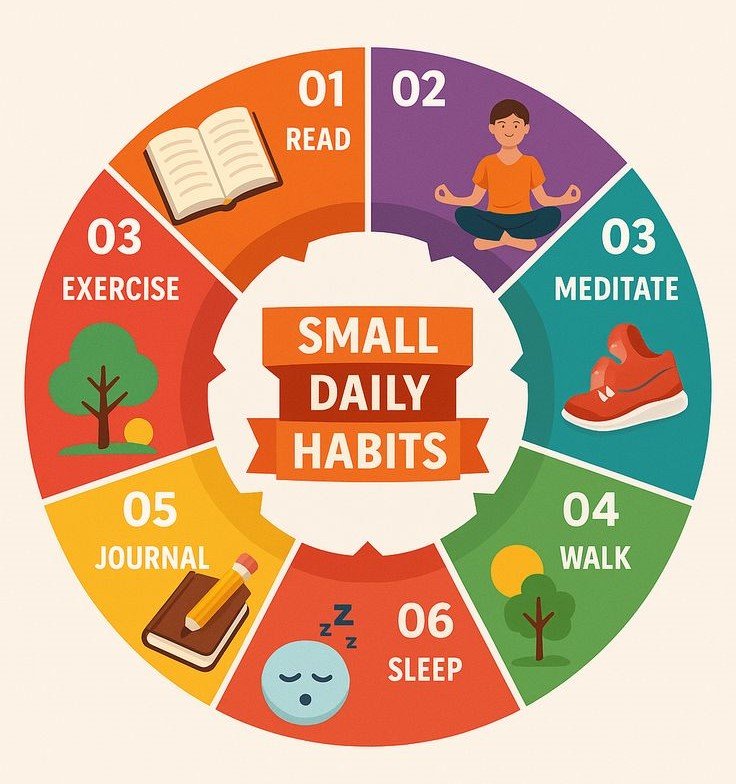
Most people wait for a dramatic turning point — a wake-up call, a new year, a fresh start — to transform their lives. But the truth hiding in plain sight is far less dramatic: the biggest changes in your life will not come from a single bold decision. They will come from the quiet, almost invisible actions you repeat every single day.
A five-minute morning walk. A glass of water before coffee. One page of a book before sleep. These are not life-changing moments. But done every day, without fail, they become life-changing habits — and habits, unlike motivation, do not run out.
This is not a theory. It is science. It is the story behind the British cycling team’s five Tour de France victories, James Clear’s bestselling framework in Atomic Habits, and the daily routines of some of the world’s most productive people. And it can be your story too.
How Tiny Daily Improvements Compound Into Massive Results
imagine improving at anything — your fitness, your focus, your finances — by just 1% every single day. In a week, that 1% feels meaningless. In a month, you might notice a small difference. But over a full year? You end up approximately 37 times better than where you started.
This is the mathematics of marginal gains, popularised by British cycling coach Sir Dave Brailsford. His team improved every single aspect of cycling performance by 1% — the angle of the bike seat, the type of pillow riders slept on, the way they washed their hands to prevent illness. The combined effect of these tiny improvements was extraordinary: Team GB went from no Tour de France victories to winning five championships in a decade.
The reverse is equally powerful and equally invisible. Decline 1% each day — sleep a little less, move a little less, eat a little worse — and within a year you are barely a fraction of your potential. The slope you are on matters far more than the step you are taking.
Science-backed Daily Habits to Improve Physical and Mental Health
When we think about change, we tend to think big. New gym membership. Strict diet. Complete lifestyle overhaul. These dramatic approaches feel powerful in January — and fall apart by February.
The reason is neurological. The human brain is wired to resist large, sudden changes. When you attempt a dramatic shift, your brain triggers a threat response, creating friction, resistance, and eventual burnout. Psychologist Dr. Wendy Wood’s research found that nearly 40% of our daily actions are driven by habits rather than conscious decisions. This means your life is largely shaped not by what you decide to do, but by what you habitually do without thinking.
Small habits work precisely because they fly under the brain’s radar. They require so little effort that the brain does not resist them. And once a small habit is anchored into your daily routine, it becomes automatic — requiring no willpower at all.
The real power, however, is in compounding.
7 Small Daily Habits That Create Big Life Results: 1. Read 10 Pages Every Day
Ten pages takes approximately 15–20 minutes. It feels trivial. But 10 pages a day is 3,650 pages a year — roughly 12 to 15 full books. In five years, you will have read 60 to 75 books more than you would have otherwise. The compounded knowledge, vocabulary, and perspective that comes from that is anything but trivial.
Start with: Keep a book on your nightstand. Read before your phone. Never miss a night.
2. Drink One Extra Glass of Water Daily
Chronic mild dehydration is one of the most common and overlooked causes of low energy, poor concentration, and afternoon brain fog. Adding just one additional glass of water to your morning routine — before coffee, before screens — starts a hydration chain that improves digestion, skin health, and mental clarity over time.
Start with: Place a glass of water next to your bed every night. Drink it the moment you wake up.
3. Move Your Body for 10 Minutes
Ten minutes of movement is not a workout. It is a habit signal. When you lace up your shoes for a 10-minute walk every morning, you are not trying to get fit — you are building the identity of someone who moves daily. Research consistently shows that regular moderate movement, even short bursts, significantly reduces the risk of heart disease, depression, and cognitive decline.
Over a year, 10 minutes a day is over 60 hours of movement you would not have had otherwise.
Start with: Walk around the block after breakfast. No gym required.
4. Apply the Two-Minute Rule
Productivity expert David Allen introduced this concept: if a task takes less than two minutes, do it immediately. Reply to the short email. Put the dish in the dishwasher. Hang up your coat. These tiny actions prevent the mental clutter of undone tasks from accumulating into an overwhelming pile of procrastination and stress.
Start with: For one week, complete every sub-two-minute task the moment you encounter it. Notice the difference.
5. Sleep 15 Minutes Earlier
Sleep is not passive recovery — it is when your brain consolidates memory, regulates hormones, repairs tissue, and resets emotional resilience. Most adults are chronically under-slept not by hours, but by minutes. Moving your bedtime back by just 15 minutes — no dramatic overhaul — gradually shifts your sleep quality, morning energy, and decision-making capacity across weeks and months.
Start with: Set a phone alarm for “wind-down time” — 30 minutes before your new target bedtime.
6. Write Three Sentences of Gratitude
Gratitude journaling has a mountain of research behind it, including studies linking it to reduced anxiety, better sleep, and improved relationships. But most people never start because they imagine it requires a full journal entry. It does not. Three sentences — three things you are genuinely thankful for — is enough to rewire your brain’s negativity bias over time.
Start with: Keep a small notebook on your desk. Write three lines every morning before checking your phone.
7. Save a Small Amount Daily
Personal finance is less about income and more about habit. Saving even a modest daily amount — say, the cost of one coffee — and channelling it into a savings account or investment vehicle activates the compounding engine of financial growth. The habit of saving is more valuable than the amount saved, because it builds the identity and the system from which larger wealth is eventually built.
Start with: Automate a small daily transfer. Remove the decision. Let the habit run on autopilot.
How to Make Small Habits Stick: The Three Laws of Tiny Change
Building a small habit is easy. Keeping it is the real challenge. Here is what behavioral science tells us actually works:
Make it obvious. Place your book on your pillow. Put a water glass on your nightstand. Lay out your walking shoes the night before. Your environment shapes your behavior more than your willpower does. Design the environment before you need the willpower.
Make it easy. The habit must require almost zero effort to begin. James Clear calls this “reducing the friction.” If your habit is going to the gym, start by just driving to the gym — even if you do not go in. The entry point must be so easy that saying no feels strange.
Make it satisfying. The brain repeats what it rewards. Track your streak. Mark a calendar. Tell a friend. The satisfaction of a visible record is a real psychological reward that reinforces the loop.
Common Mistakes That Kill Small Habits
Trying to build too many habits at once. Pick one. Only one. Once it is fully automatic — typically after 60 to 90 days — add the next.
Relying on motivation instead of systems. Motivation is an emotion. It fluctuates with mood, weather, and how many hours you slept. Systems do not. Build the system; do not wait for the feeling.
Breaking the chain and giving up. Missing one day does not ruin a habit. Missing two days consecutively starts a new one — the habit of not doing it. The rule: never miss twice. One missed day is an accident. Two is the beginning of a pattern.
Measuring progress too early. Most small habits produce no visible results for four to six weeks. This is the period when people quit. The results come — they always come — but only to those who stay patient enough to wait for the compounding to become visible.
The Identity Shift: From “Doing” to “Being”
The most powerful thing about small daily habits is not what they produce. It is what they prove. Every time you complete a small habit, you cast a vote for the person you are becoming. Read one page — you are a reader. Walk for ten minutes — you are someone who moves daily. Save a small amount — you are someone who builds wealth.
James Clear puts it this way: the goal is not to read a book, it is to become a reader. The goal is not to run a race, it is to become a runner. When your habits align with your identity, they stop feeling like tasks and start feeling like expression.
This is the deepest transformation small habits offer. Not just better health, or more productivity, or financial growth — but a fundamentally different understanding of who you are and what you are capable of.
Conclusion: Start Smaller Than You Think You Should
If you are waiting for the perfect moment to change your life, this is it. Not because of some grand resolution, but because of one tiny action taken today, and again tomorrow, and the day after that.
The gap between who you are and who you want to be is not closed by a dramatic leap. It is closed by a series of almost invisible steps, each one compounding on the last, until one day you look back and barely recognize the distance you have traveled.
Start smaller than you think you should. Stay consistent longer than feels necessary. Trust the math.
The results will follow.